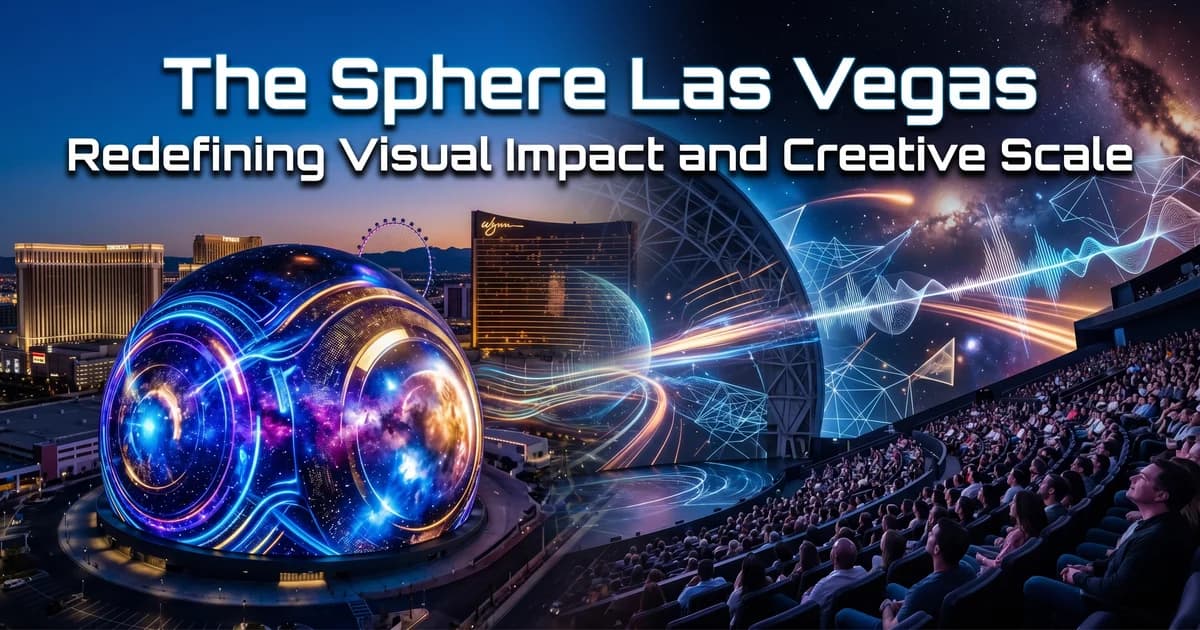
The Sphere in Las Vegas is the most visible example of immersive display engineering in the US. Beyond the spectacle, it is a large-scale systems problem: moving enormous volumes of media through storage, rendering, synchronization, and display hardware with no tolerance for visible failure. The same constraints appear, at smaller scale, in enterprise 3D platforms, digital twins, product configurators, and experiential retail. This article extracts the engineering lessons for teams building immersive or high-throughput visual systems.
Scale as an Engineering Constraint
Publicly reported specifications show the scale involved: an interior display of roughly 160,000 square feet at 16K by 16K resolution, and an exterior surface of about 580,000 square feet built from roughly 1.2 million LED pucks. Reporting on the venue's media systems also describes large GPU clusters for rendering and flash storage arrays sized for sustained high-bandwidth playback. The design implications are general:
- Throughput is the product: If storage and network bandwidth cannot sustain peak frame data, rendering power is irrelevant.
- Synchronization is visible: Small timing errors across display zones appear as tearing or seams that audiences notice immediately.
- Failure is public: Redundancy and graceful degradation matter more when the output is live.
Reference Architecture for a High-Throughput Media Pipeline
- Content and asset management: Version-controlled assets, naming conventions, and automated validation catch format and resolution problems before they reach production.
- Storage tier: High-speed flash and caching layers sized for peak read bandwidth, with replication for failover.
- Rendering layer: GPU clusters render in real time or play back pre-rendered media, with workloads partitioned by display region.
- Distribution and synchronization: Frame-accurate timing across nodes, with low-latency networking and clock synchronization.
- Control and monitoring: Operators see node health, frame timing, temperature, and error rates in a single console, with automated failover.
Our real-time data and monitoring engineering applies the same telemetry practices to render farms, kiosks, and live visualization systems.
Lessons for Enterprise 3D and Visualization Platforms
- Digital twins and operations views: Live 3D models of facilities or equipment depend on the same data-to-render pipeline, with sensor updates driving the scene.
- Product configurators: Real-time 3D lets B2B buyers customize complex products and reduces quoting cycles.
- Experiential retail and showrooms: Large-format displays and interactive installations need content workflows that non-engineers can operate.
- Training and simulation: Immersive environments improve retention for complex procedures, but only when frame rates stay stable.
Bringing Immersive Performance to the Web
Browser-based 3D has its own constraints: variable devices, limited memory, and unpredictable networks. Production teams set frame-rate and load-time budgets, compress geometry and textures, use level-of-detail switching, and stream assets progressively so the first interaction happens quickly. WebGL and emerging WebGPU capabilities make rich scenes possible, but disciplined asset pipelines decide whether they run smoothly on a mid-range laptop. Our advanced web and 3D platform development builds Next.js experiences with these budgets enforced in the build pipeline.
Design and Content Workflow
Spectacular output starts with disciplined design systems. Spatial UI, motion standards, color management, and content templates keep experiences consistent across displays and devices. Technical artists and engineers should share a pipeline, with agreed resolution, frame-rate, and file-format standards from the first concept. Our 3D animation and creative studio works within that kind of engineering-aware workflow.
When Immersive Investment Pays Back
Immersive systems justify their cost when they change a business outcome: shorter sales cycles through interactive product demos, higher engagement at events and showrooms, fewer prototypes through digital twins, or better operator training. Define the metric first, such as qualified leads per event, quote turnaround time, or training completion rates, and build the smallest system that can move it. Scale up only after the pilot shows results.
Engineer Your Next High-Impact Digital Experience
Black Zero Technologies combines software engineering, real-time data pipelines, and 3D design for US enterprises, with full code ownership and US time-zone overlap. We begin by defining the experience, the performance budget, and the data it needs to run.
Get a Custom Software Estimate or Book a Scoping Call to scope your immersive or 3D platform.
Sphere is a trademark of Sphere Entertainment Co. Black Zero Technologies is not affiliated with or endorsed by the venue. Specifications cited are from public reporting.