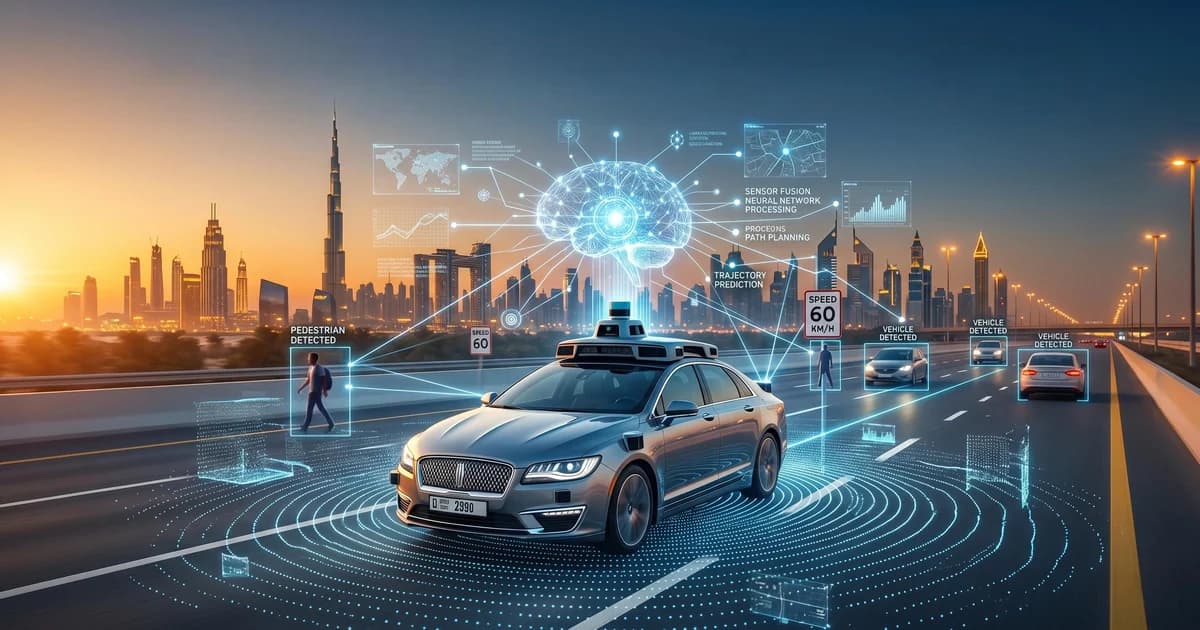
Autonomous vehicles are the most demanding public example of edge AI: a machine that must perceive a changing environment, decide, and act within tight latency limits, with safety consequences if it fails. The engineering patterns behind these perception stacks, namely multi-sensor fusion, edge inference, continuous data pipelines, and rigorous validation, transfer directly to fleets, warehouse and yard automation, robotics, and industrial inspection. This article breaks down that architecture and what enterprise teams can reuse.
Multi-Modal Sensing and Its Trade-Offs
Each sensor type fails in different conditions, which is why autonomous systems combine several rather than trusting one.
| Sensor | Primary Function | Strength | Weakness |
|---|---|---|---|
| Cameras | Object, lane, sign, and signal classification | Rich color and texture detail at low cost | Degraded by glare, darkness, and weather |
| Radar | Distance and relative velocity | Performs well in rain, snow, and fog | Lower spatial resolution |
| LiDAR | 3D point-cloud depth mapping | Precise geometry, independent of ambient light | Cost, and reduced performance in heavy precipitation |
Reference Architecture for a Perception and Fusion Stack
- Synchronization and calibration: Sensor streams are timestamped against a common clock and calibrated to a shared coordinate frame, because small misalignments corrupt every downstream result.
- Per-sensor perception: Neural networks detect and classify objects within each modality.
- Fusion: Early, mid-level, or late fusion combines modalities into one scene representation, chosen by latency budget and failure tolerance.
- Tracking and prediction: Objects are tracked over time, and models forecast their motion so the planner can act before conflicts arise.
- Planning and control: Rule-based safety layers constrain what learned components can command.
- Health monitoring: Diagnostics detect sensor degradation and trigger fallback behavior.
Our computer vision and AI engineering team applies these patterns to enterprise robotics, inspection, and fleet systems.
Edge AI Constraints: Latency, Power, and Reliability
Edge inference runs on constrained hardware with strict latency and power budgets, so models are quantized, pruned, and compiled for specific accelerators. Define an end-to-end latency budget from sensor capture to actuation, and test it under worst-case load, not average conditions. Build redundancy for safety-critical paths, and design the system to degrade safely when a sensor or compute node fails.
The Data Engine Behind the Model
- Collection: Devices log edge cases and low-confidence events, rather than uploading everything.
- Labeling and curation: Pipelines prioritize rare scenarios, with quality checks on annotations.
- Training and evaluation: Versioned datasets and reproducible experiments tie each model to the data that produced it.
- Deployment: Staged over-the-air rollouts with monitoring and fast rollback.
This loop is a data engineering problem as much as a modeling one. Our data analytics and pipeline engineering builds the telemetry, storage, and dashboards that keep it running.
Validation, Safety, and Security
Safety-critical systems rely on layered evidence: simulation across large scenario libraries, closed-course testing, and monitored field deployment. Functional safety and safety-of-the-intended-function standards, such as ISO 26262 and ISO 21448 in automotive, offer frameworks that industrial teams adapt to their own domains. Treat cybersecurity as part of safety: secure boot, signed updates, encrypted communications, and network segmentation protect vehicles and machines from remote compromise.
Applying the Architecture to Enterprise Operations
- Fleet and logistics: Driver-assist analytics, collision-risk detection, and yard automation.
- Warehouse and industrial robotics: Navigation, obstacle avoidance, and inventory scanning.
- Inspection and monitoring: Vision systems on drones and fixed cameras that fuse multiple sensors.
Operators need a control layer on top. Our web platform and portal development delivers fleet consoles, alert workflows, and reporting that connect machine data to business decisions.
Engineer Edge AI for Your Operations
Black Zero Technologies builds computer vision pipelines, telemetry systems, and edge AI applications for US enterprises, with full code ownership and US time-zone overlap. We begin by defining your sensors, latency requirements, and the decisions the system must make.
Get a Custom Software Estimate or Book a Scoping Call to scope your edge AI project.