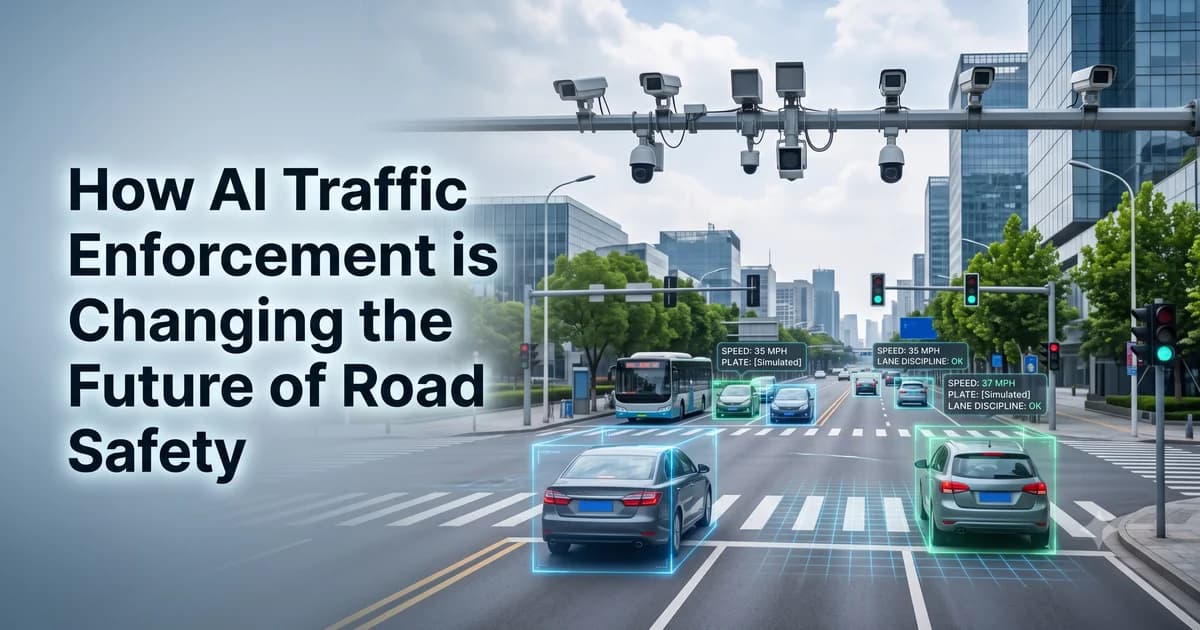
How AI Traffic Enforcement is Changing the Future of Road Safety
For decades, the image of a traffic ticket has been synonymous with a flashing blue light in the rearview mirror. A human officer observes an infraction, pulls the driver over, and issues a citation. However, the landscape of road law enforcement is undergoing a quiet, high-tech transformation. Artificial intelligence is moving from the realm of science fiction into the heart of traffic management, fundamentally changing how we monitor, detect, and penalize driving behavior.
Beyond the Human Eye
Traditional traffic enforcement is limited by the number of officers available and the fallibility of human perception. An officer can only monitor one stretch of road at a time. AI, conversely, never sleeps. Modern Intelligent Traffic Management Systems (ITMS) use high-definition cameras combined with deep learning algorithms to monitor intersections and highways 24/7.
These systems do more than just record footage. Using computer vision, AI can track vehicle velocity, lane positioning, and adherence to signal lights with near-perfect precision. Algorithms can distinguish between a vehicle making a legal right turn on red and one that blatantly blows through a signal. By processing thousands of data points in real time, these systems act as a force multiplier for law enforcement, identifying violations that might otherwise go unnoticed.
Traditional vs AI Traffic Enforcement Methods
| Enforcement Feature | Traditional Police Monitoring | AI Traffic Enforcement Systems |
|---|---|---|
| Operational Hours | Limited by shift schedules | 24/7 continuous road surveillance |
| Detection Accuracy | Subject to human visual limits | Advanced computer vision and precision |
| Citation Process | Manual roadside traffic stops | Automated digital ticket generation |
| Data Processing | Single event observation | Tracks thousands of data points instantly |
The Mechanism of Automated Enforcement
How exactly does AI issue a ticket? It typically follows a structured digital workflow:
- Detection: As a vehicle enters a monitored zone, sensors and cameras capture its movement.
- Analysis: The AI software analyzes the motion to determine if a traffic rule was broken. For example, it calculates the time elapsed between a light turning red and the vehicle crossing the intersection line.
- Verification: Sophisticated algorithms read the license plate and cross-reference it with vehicle registration databases.
- Documentation: The system generates a high-quality snapshot or video clip of the infraction as legal evidence.
- Issuance: In many jurisdictions, the evidence is automatically forwarded to human oversight, where an official confirms the data before a citation is mailed to the registered owner.
Efficiency vs. Privacy
The primary argument for AI-driven enforcement is improved public safety. By automating the detection of dangerous behaviors—such as speeding in school zones or illegal intersection entries—cities can reduce accident rates without needing a massive police presence. AI removes the element of bias or human error from the initial detection phase, theoretically making the process more objective.
However, the rapid adoption of this technology has sparked a necessary debate regarding privacy. When AI is constantly recording and analyzing the movement of every vehicle, where is the line drawn? Critics argue that constant surveillance creates a "big brother" environment, where every commute is logged and categorized. Additionally, there are concerns about the lack of human discretion; an AI cannot distinguish between a driver speeding to bypass traffic and a driver rushing to a hospital emergency.
The Road Ahead
As we look toward 2026 and beyond, the role of AI in traffic enforcement will only expand. We are already seeing the integration of AI into smart city infrastructure, where traffic lights adjust using real-time data processing based on vehicle density. As these systems become more integrated with autonomous vehicle technology, the concept of a traffic ticket may eventually evolve. One day, your car might communicate directly with the traffic system, receiving an instant alert or adjustment if you inadvertently violate a safety protocol.
The "AI behind the ticket" is ultimately a double-edged sword. It offers the promise of safer, more efficient roads, but it requires a careful balance between technological progress and the protection of civil liberties. One thing is certain: the era of the high-tech traffic ticket has arrived, and it is here to stay.