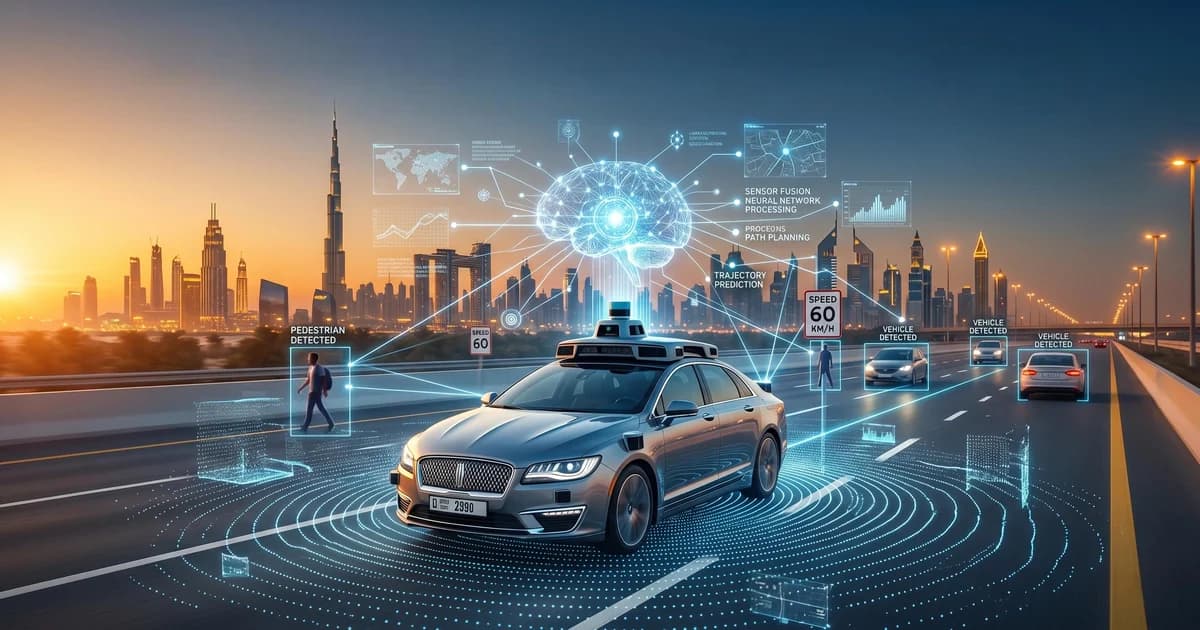
The dream of vehicles navigating city streets in Dubai without human intervention is rapidly shifting from a futuristic concept to an everyday reality. Artificial intelligence stands directly at the centre of this profound transportation revolution across the UAE. Autonomous cars in the Middle East do not simply follow a preprogrammed route. They dynamically observe their environment, interpret complex scenarios, and react to a chaotic world in real time.
Understanding how these highly complex machines work reveals the immense power of modern artificial intelligence. We can break down the operation of autonomous vehicles into three fundamental phases: sensing the environment, processing the data through an artificial brain, and executing physical action.
Sensing the Environment:
A self-driving car in Dubai requires an uninterrupted stream of high-fidelity data to navigate safely. The vehicle acts as a massive data collection platform on wheels, processing gigabytes of information every second through an array of specialized sensors.
Cameras are positioned around the entire frame to provide complete visual coverage. These optical devices act exactly like human eyes. They are essential for reading speed limit signs, detecting traffic light colours, identifying lane markings, and spotting pedestrians on busy UAE roads.
Radar sensors emit radio waves that bounce off surrounding objects to measure distance and relative speed. Radar is incredibly robust and excels in challenging weather conditions, such as heavy rain or thick fog across the Gulf region, where optical cameras might experience severe visibility issues.
LiDAR systems fire millions of precise laser pulses every second in all directions. By measuring the exact time it takes for each laser beam to reflect, the system builds an incredibly detailed 3D map of the world. This gives the car an exact sense of depth.
| Sensor Technology | Primary Function | Advantage for Dubai Climate |
|---|---|---|
| Optical Cameras | Visual object and sign detection | High resolution for clear sunny days |
| Radar Sensors | Distance and speed measurement | Penetrates sandstorms and thick fog |
| LiDAR Systems | Detailed 3D depth mapping | Operates flawlessly in low-light conditions |
The AI Brain:
Collecting petabytes of sensor data is only the initial step. The vehicle must make logical sense of this massive influx of information instantaneously. This is where centralized computing platforms powered by deep neural networks take absolute control.
Through computer vision, the software performs object detection. Within milliseconds, the system must differentiate between a bicyclist filtering through traffic and a stray animal running into the road.
Because no single sensor is perfect, the system uses sensor fusion. By blending the data from cameras, radar, and LiDAR, the AI brain creates a singular and highly accurate model of reality. If one sensor fails, the other systems instantly fill the gaps.
Once the AI establishes a clear understanding of its surroundings, it must predict what will happen next. It calculates the trajectories of surrounding actors and determines the safest route forward. It continuously updates this plan multiple times per second.
Taking Physical Action
After the AI brain determines the optimal path, it translates these digital decisions into physical movements. The onboard computer sends precise electronic commands to mechanical components known as actuators. One actuator rotates the steering column, another modulates the braking system, and a third manages the electronic throttle. The AI executes these adjustments with millisecond precision, reacting much faster than a human ever could.
The Critical Role of Mapping
A common misconception is that autonomous vehicles rely solely on live sensor data to find their way. In reality, prior knowledge plays an equally massive part in safe navigation.
Autonomous cars rely on high-definition maps. These are incredibly detailed digital blueprints of the roadway network that are accurate down to the single centimetre. HD maps contain preloaded data regarding lane widths, exact curb heights, and the location of every single crosswalk. When a car drives down a street in Dubai, it constantly compares its live sensor data against this preloaded map to localize itself with extreme accuracy.
The Road Ahead
The automotive industry categorizes these advancements into different levels of autonomy, ranging from basic driver assistance at Level 1 to full automation at Level 5. As machine learning algorithms become more proficient and custom silicon chips allow faster processing, vehicles will continue to scale rapidly toward Level 5. Eliminating human error will save countless lives globally. The rigorous training of these neural networks ensures that autonomous vehicles in the UAE will eventually make our roads significantly safer and our commutes far more productive.
Conclusion
Embracing the evolution of automated transportation is no longer a matter of the distant future. The deployment of advanced neural networks and deep learning models guarantees that autonomous vehicles will eventually make our streets significantly safer and our commutes far more productive. As cities across the United Arab Emirates invest heavily in smart city development, tracking how the AI brain inside self-driving cars operates gives business leaders a clear blueprint of how intelligent software can master complex, real-world environments.
Revolutionize Your Software Architecture with Black Zero
Automating complex operations requires elite engineering. At Black Zero, we build high-performance intelligent software solutions, scalable digital frameworks, and custom artificial intelligence models designed to solve your toughest technical challenges.
Do not let outdated systems hold your enterprise back in a rapidly evolving marketplace. Partner with our data scientists and software engineers today to transform your business data into a powerful asset. Contact Black Zero right now to schedule your technical consultation and dominate your industry.