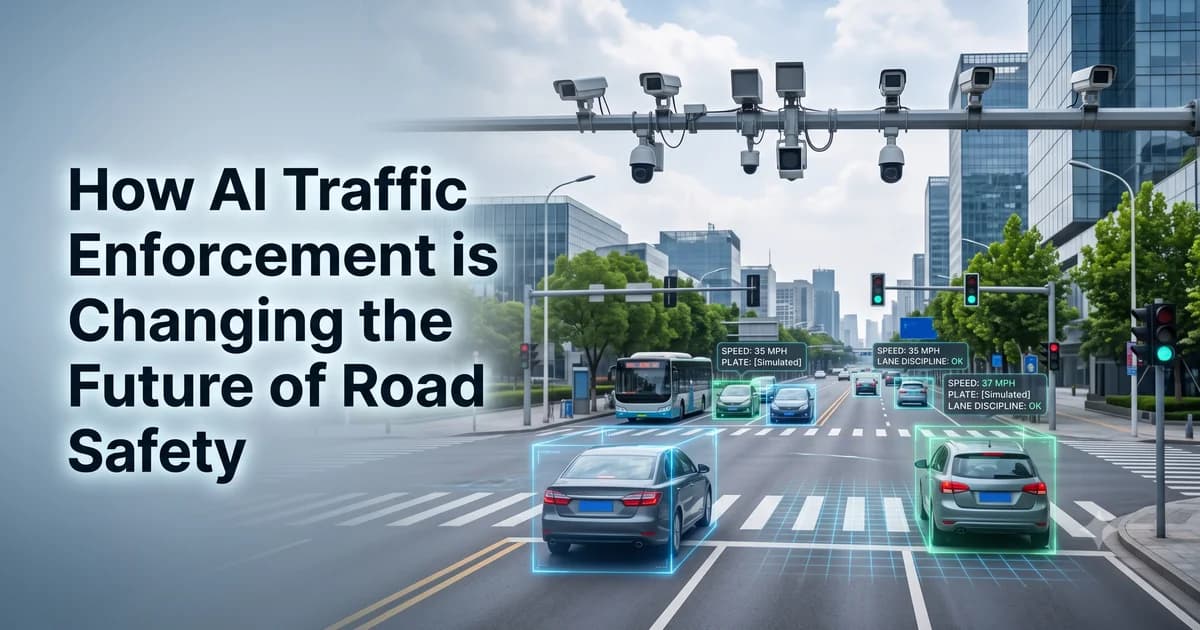
Cities, toll operators, campuses, and logistics hubs are all adopting computer vision to measure and manage traffic. For the vendors and integrators who build these systems, the hard problems are not detection accuracy alone. They are chain-of-custody for evidence, human review workflows, privacy compliance, and keeping thousands of edge devices running reliably. This article describes the architecture of an intelligent transportation system (ITS) analytics platform and the engineering decisions that make it deployable.
System Scope: Analytics First, Enforcement Second
Automated enforcement is only one use case, and its legality varies by state and municipality. Many deployments begin with analytics: vehicle counts, speed distributions, near-miss detection, queue lengths, and signal-timing data. The same pipeline can later support enforcement workflows where local law permits, so the architecture should treat enforcement as a configurable module rather than a core assumption.
Reference Architecture
- Sensing: High-definition cameras, with radar or loop sensors where precise speed measurement is required.
- Edge inference: On-device models detect and classify vehicles, track trajectories, and read license plates through optical character recognition.
- Event engine: Rules and models turn tracks into events such as signal violations, wrong-way movement, stopped vehicles, or incidents.
- Evidence service: Packages images, video clips, timestamps, and sensor data into signed, tamper-evident records.
- Review queue: Human reviewers confirm or reject each event before any downstream action.
- Integration layer: APIs deliver confirmed events to records systems, court or citation platforms, and analytics warehouses.
Our computer vision and AI engineering team builds the detection, tracking, and recognition models, with performance tested on local camera angles and lighting.
Edge vs. Cloud Processing
| Concern | Edge Processing | Cloud Processing |
|---|---|---|
| Latency | Immediate local decisions | Depends on network round trip |
| Bandwidth | Sends only events and clips | Streams continuous video |
| Privacy | Raw video can stay on device | More data in transit and storage |
| Fleet management | Requires remote update and monitoring tooling | Centralized updates and scaling |
Most deployments split the work: inference at the edge, storage and analytics in the cloud.
Evidence Integrity and Human Review
Any system that can lead to a penalty must withstand scrutiny. Sign each evidence package at capture, log every access and decision, and keep a human reviewer in the loop for every confirmed event. Record the model version and confidence behind each detection so errors can be traced and corrected. Build review tools that make accurate decisions fast, with side-by-side clips, plate crops, and clear reason codes. Our web platform development team builds these review portals and reporting consoles.
Accuracy, Fairness, and Auditing
- Site-specific validation: Measure precision and recall at each deployment, since angles, lighting, and weather change performance.
- Plate recognition errors: Cross-check reads against registration data and flag low-confidence results for review.
- Independent audits: Sample confirmed and rejected events regularly to detect drift and systematic error.
- Transparent metrics: Report false-positive rates and corrections to the agency or customer.
Privacy and Regulatory Considerations
License plate and traffic-camera data is regulated differently across US states, covering retention periods, data sharing, and permitted uses. Define retention schedules, access controls, and audit logs per jurisdiction, minimize storage of footage that contains no events, and have counsel review procurement and data-sharing terms. Public-sector buyers also expect security documentation, such as encryption standards, penetration test results, and incident response plans.
Analytics and Operations Value
Aggregated, anonymized traffic data supports signal retiming, safety audits, and infrastructure planning. Pipelines that feed real-time analytics dashboards let agencies compare corridors, measure the effect of changes, and prioritize spending with evidence rather than anecdotes.
Build a Transportation Analytics Platform
Black Zero Technologies engineers computer vision pipelines, evidence and review systems, and analytics dashboards for US transportation vendors, integrators, and operators, with full code ownership and US time-zone overlap. We begin by defining your use cases, jurisdictions, and device environment.
Get a Custom Software Estimate or Book a Scoping Call to scope your transportation platform.