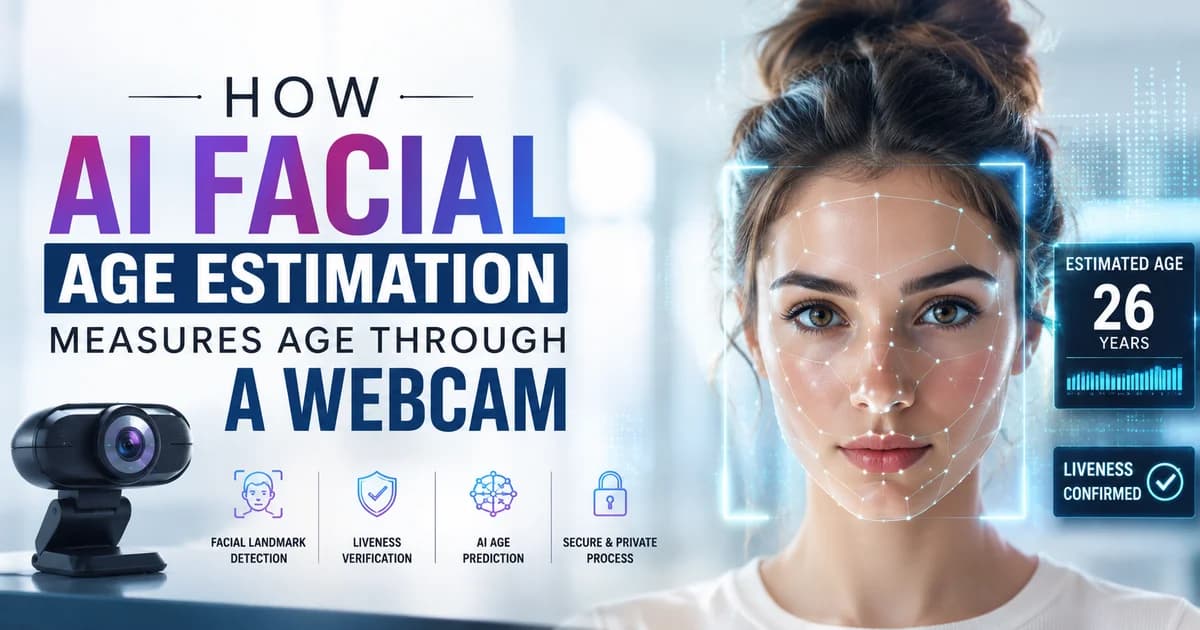
Age-restricted commerce, gaming, and online safety rules are pushing US platforms to verify age without turning every checkout into a document upload. Facial age estimation through a standard webcam is one answer, and it is a demanding engineering problem: the system must make a reliable threshold decision in seconds, resist spoofing, protect biometric data, and perform fairly across users. This article covers the architecture of a webcam age-assurance pipeline and the decisions that determine whether it is deployable in the US.
What Age Assurance Actually Requires
Most businesses do not need an exact age. They need a defensible answer to one question: is this person above a legal threshold? That reframes the model's job. Rather than reporting a single predicted age, a well-designed system compares an estimate and its uncertainty against a threshold with a safety buffer, and routes borderline cases to a stronger check such as document verification. Designing the fallback path is as important as designing the model.
Pipeline Architecture
- Capture and quality gating: The browser requests camera permission, then checks lighting, face size, pose, and blur, and prompts the user to correct problems before analysis.
- Face detection and landmarking: A lightweight detector locates the face and key landmarks, which align and crop the image for the downstream model.
- Liveness detection: Passive and active checks confirm a live person is present, rather than a photo, a replayed video, or a synthetic stream.
- Age estimation model: A neural network trained on diverse, consented data produces an age estimate with an uncertainty measure.
- Decision engine: Business rules apply the threshold and buffer, and return a pass, fail, or escalate result to the calling application.
- Audit layer: Records the outcome, model version, and confidence, without retaining the image.
Our computer vision and AI engineering team builds each stage as an independent service, so models can be updated without redeploying the whole system.
Liveness and Spoof Resistance
Presentation attacks include printed photos, screen replays, and masks. Injection attacks, where a virtual camera feeds prerecorded or generated video into the browser, are increasingly common. Layer defenses: texture and depth cues, challenge-response movements, device and stream integrity checks, and rate limiting on repeated attempts. No single technique is sufficient, so test the system with a red-team set of attack types and track attack success rates over time.
Threshold Decisions and Error Trade-offs
Every threshold trades false accepts, where an underage user passes, against false rejects, where an adult is blocked. Setting a challenge age above the legal minimum reduces false accepts and sends more users to fallback verification. Choose the buffer by risk: a gambling or adult-content platform needs a larger margin than a loyalty-program age check.
Privacy and Legal Design
- Biometric privacy laws: Statutes such as the Illinois Biometric Information Privacy Act and similar laws in Texas and Washington may apply to face-based processing. Obtain legal review of consent, notice, and retention requirements for each state you serve.
- Data minimization: Run inference on the device where feasible, process frames in memory, and avoid storing images or face templates.
- Clear consent: Explain what is analyzed, why, and what happens to the data, before camera access is requested.
- Evolving age-verification rules: State requirements differ and change, so keep the threshold and fallback logic configurable by jurisdiction.
Fairness Testing and Monitoring
Accuracy varies with age range, skin tone, gender presentation, camera quality, and lighting. Evaluate error rates across these groups before launch, publish internal thresholds for acceptable disparity, and monitor production outcomes for drift. Dashboards that track pass rates, escalation rates, and device mix, built with data analytics engineering, surface problems early.
Integration Patterns
- E-commerce checkout: A pre-payment check for age-restricted goods that falls back to ID when results are borderline.
- Gaming and community platforms: Age gating for content tiers and chat features.
- Telehealth and regulated services: Lightweight eligibility checks before onboarding.
- Delivery model: A JavaScript SDK or hosted flow built by our web platform developers, with webhook results to your backend.
Build a Privacy-First Computer Vision System
Black Zero Technologies engineers custom age-assurance and computer vision systems for US platforms, with privacy-by-design architecture, full code ownership, and US time-zone overlap. We begin with a scoping session on your risk profile, jurisdictions, and fallback flows.
Get a Custom Software Estimate or Book a Scoping Call to scope your age-assurance project.
Frequently Asked Questions
Does facial age estimation have to store images?
No. A privacy-first design processes frames in memory, ideally on the device, and retains only the outcome and audit metadata. Your retention policy and applicable biometric privacy laws should govern the final design.
Can a photo or video replay defeat the system?
Basic spoofs should be blocked by liveness checks, but no defense is absolute. Layered liveness, stream integrity checks, and regular red-team testing reduce the risk.
How accurate is webcam age estimation?
Accuracy depends on the model, image quality, and the user's age range, and it is typically weakest near the threshold. For that reason, production systems use a buffer age and route borderline users to document verification.
Why use AI age estimation instead of ID checks?
It reduces friction and avoids collecting identity documents for most users, which lowers data liability. ID verification remains the right fallback for borderline or high-risk cases.