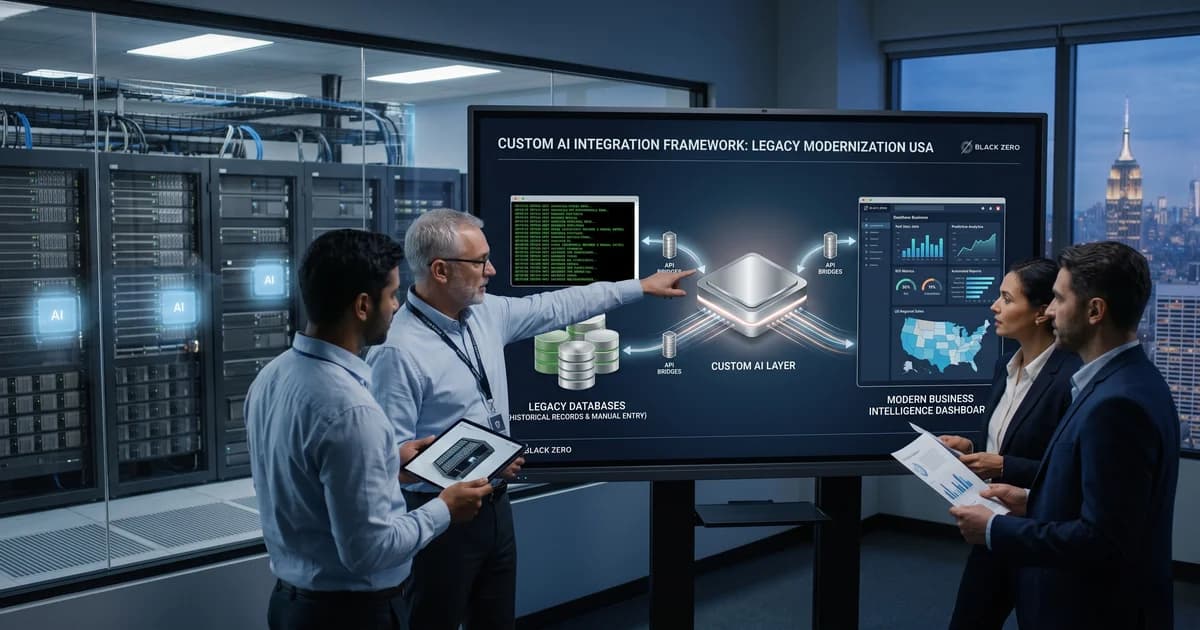
Core operations at many US enterprises still run on ERP, banking, or logistics software that is a decade or more old. These systems hold years of transaction history and encode business rules nobody fully documented, which makes a full rewrite slow, costly, and risky. Custom AI can be added around a legacy platform instead of in place of it. This guide covers the integration patterns, safeguards, and rollout approach that let you gain automation and predictive capability without disrupting the systems the business depends on.
Why Legacy Systems Resist AI
- No modern interfaces: Many platforms expose only batch files, database tables, or terminal screens rather than APIs.
- Embedded business logic: Pricing, approval, and compliance rules live in stored procedures or custom code that cannot be safely altered.
- Inconsistent data: Decades of manual entry leave duplicates, free-text fields, and conflicting formats.
- Tight coupling and fragility: A small change can disrupt downstream jobs, so teams avoid touching the core.
These constraints shape the integration strategy. The goal is to add capability at the edges, keep the system of record stable, and move logic outward over time.
Integration Patterns That Work
- API wrapper layer: A secure service translates legacy interfaces into documented REST or GraphQL endpoints, so AI services never touch the core directly. This anti-corruption layer isolates new code from old schemas.
- Change data capture: Database changes stream to a message broker without adding query load, giving AI services a near-real-time copy of operational data.
- File and queue bridging: Where integration is file-based, such as EDI or flat-file exports, a queue-backed ingestion service parses, validates, and routes records automatically.
- Robotic process automation: Reserve UI automation for systems with no other access path, because it is the most brittle option.
Our custom AI and software engineering team selects the pattern per system, based on data access, latency needs, and risk tolerance.
AI Use Cases That Fit Legacy Environments
- Document intake: Extracting fields from invoices, purchase orders, and claims, then posting validated records into the legacy system.
- Forecasting and anomaly detection: Models trained on historical data flag demand shifts, pricing errors, and unusual transactions.
- Knowledge access: Retrieval-augmented assistants answer questions over legacy records and documentation, reducing dependence on a few veteran experts.
- Workflow triage: Classification routes exceptions and requests to the right team with context attached.
Models depend on dependable inputs, so legacy data usually needs profiling and cleansing first. Our data analytics engineering builds the ETL and quality checks that make historical records usable for training and inference.
Modernize Incrementally With the Strangler Pattern
Rather than replacing the platform at once, route specific functions through new services one at a time. Each migrated function, such as invoicing, inventory, or quoting, is rebuilt behind the wrapper, validated against legacy output, and then switched over. Over time the old system shrinks to a data store and finally retires. Where a full replacement is the end goal, a custom ERP platform can absorb these functions progressively, so the business never faces a single high-risk cutover.
Security, Compliance, and Risk Controls
- Least privilege: Grant AI services read-only access first, with dedicated service accounts and network segmentation.
- Data protection: Mask personal and financial fields before they reach models, and keep sensitive data inside your tenancy.
- Shadow mode: Run models alongside human decisions and compare results before any automated action is enabled.
- Rollback and approvals: Keep feature flags, versioned models, and human approval for high-impact actions.
- Audit trails: Log every input, output, and override to support compliance review.
A 90-Day Roadmap
In weeks one to three, inventory systems, map data flows, and rank use cases by value and feasibility. In weeks four to eight, build the wrapper and ingestion pipelines, then train and validate a model in shadow mode. In weeks nine to twelve, pilot with one team, measure against baseline, and decide on expansion. Treat documentation as a deliverable, since capturing the legacy business rules during this work is itself an asset that reduces future risk.
Cost and ROI Versus a Rewrite
A rewrite carries long timelines, parallel-run costs, and the risk of losing undocumented behavior. Incremental integration delivers value in the first release and spreads spend over measurable milestones. Quantify returns through manual hours eliminated, error and rework reduction, faster cycle times, and decisions improved by prediction. Start with one workflow where data is accessible and volume is high, prove the result, and reuse the wrapper, pipelines, and monitoring for each additional use case.
Add AI to Your Core Systems Without Disruption
Black Zero Technologies integrates custom AI with legacy ERP, finance, and logistics platforms for US mid-market and enterprise teams, with full code ownership and US time-zone overlap. We begin with a system assessment that maps data access, risks, and the first high-return use case.
Get a Custom Software Estimate or Book a Scoping Call to assess your legacy integration options.