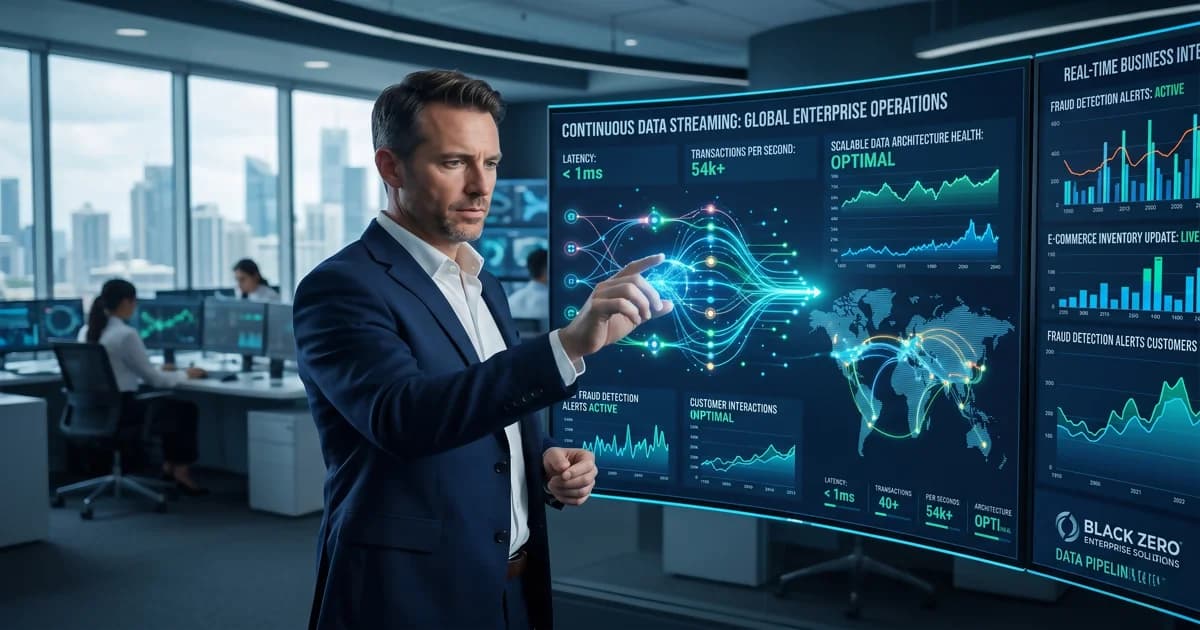
Overnight batch reports leave US enterprises managing yesterday's problems: stock that was oversold hours ago, fraud that cleared before anyone saw it, and service incidents discovered by customers first. Real-time data processing closes that gap by capturing, transforming, and acting on events as they occur. It is also expensive to build badly. This guide covers where low latency pays back, the architecture that supports it, and the engineering controls that keep it reliable at enterprise scale.
When Real-Time Processing Is Worth the Investment
Not every report needs sub-second freshness. Streaming adds infrastructure, monitoring, and engineering complexity, so apply it where delay has a measurable cost. Strong candidates share a pattern: a decision or automated action that loses value as time passes.
- Fraud and anomaly detection: Flagging irregular transactions or billing changes before settlement.
- Inventory synchronization: Updating stock across warehouses, storefronts, and order systems so promises to customers match reality.
- Operational monitoring: Detecting equipment, application, or logistics failures while there is still time to intervene.
- Customer-facing experiences: Live order tracking, pricing, and personalization driven by current activity.
Workloads like monthly financial consolidation remain well served by scheduled batch jobs. A sound design uses both, with a clear rule for which data needs which latency tier.
Reference Architecture for Real-Time Enterprise Data
- Event capture: Change data capture streams database updates from ERP and transactional systems without adding load to production queries, while application services publish domain events.
- Streaming backbone: A distributed log such as Apache Kafka buffers events durably, decouples producers from consumers, and allows replay after failures.
- Stream processing: Engines such as Apache Flink or Spark Structured Streaming apply filtering, enrichment, windowed aggregation, and rule or model scoring in flight.
- Serving layer: Processed results land in low-latency stores and in the warehouse, so live views and historical analysis share the same data.
- Delivery: WebSockets and event-driven APIs push updates to dashboards, applications, and downstream automation.
Our data analytics engineering team designs these pipelines around your existing databases and cloud provider, so adoption does not require replacing core systems.
Connecting Streams to ERP and Operational Systems
Streaming creates value only when it changes what systems do. A custom ERP platform can consume inventory and order events directly, reallocating stock, triggering replenishment, and flagging exceptions without manual review. Delivering the results to people matters equally. Executives and operators need live views that load quickly and stay accurate under heavy concurrency, which is a front-end engineering problem as much as a data one. Our advanced web and portal development builds these interfaces on Next.js with real-time update channels.
Engineering Controls for Reliability at Scale
- Delivery guarantees: Use idempotent consumers and transactional writes so retries and failures never double-count an order or payment.
- Backpressure and scaling: Partition topics by business key, autoscale consumers, and set limits so traffic spikes degrade gracefully instead of failing.
- Schema management: A schema registry with compatibility rules prevents one team's change from breaking downstream consumers.
- Late and out-of-order data: Event-time windows and watermarks keep aggregates correct when events arrive delayed.
- Observability: Track end-to-end latency, consumer lag, and error rates, with alerts tied to business impact.
Managed Services vs. Custom Engineering
Managed streaming services reduce operational burden, while self-managed clusters offer more control over cost and data residency. Many enterprises choose managed Kafka or a cloud-native equivalent for the backbone and invest custom engineering in processing logic, domain models, and integration, where differentiation lives. Whichever you choose, keep business logic portable and documented, and retain ownership of the code that encodes your operating rules, so a change in infrastructure vendor does not become a rewrite.
Security and Compliance in Streaming Systems
Data in motion needs the same discipline as data at rest. Encrypt traffic and storage, enforce role-based access at topic level, mask sensitive fields such as payment and personal data before they reach broad consumers, and retain audit logs of who accessed which streams. Define retention periods that satisfy regulatory requirements without storing more than the business needs.
Cost and ROI
Build the business case from avoided losses and recovered capacity: fraud prevented, stockouts and oversells reduced, downtime shortened, and analyst hours no longer spent reconciling delayed reports. Control infrastructure cost by tiering data by freshness requirement, compacting retained topics, and right-sizing processing clusters. Begin with one high-value event flow, such as inventory or transaction monitoring, and extend the platform only after it has demonstrated measurable results.
Plan Your Real-Time Platform With Engineers Who Build It
Black Zero Technologies designs and delivers custom streaming pipelines, operational dashboards, and ERP integrations for US mid-market and enterprise teams, with full code ownership and US time-zone overlap. We start by identifying the decisions where latency costs you most and scoping the first production flow.
Get a Custom Software Estimate or Book a Scoping Call to define your first real-time use case.