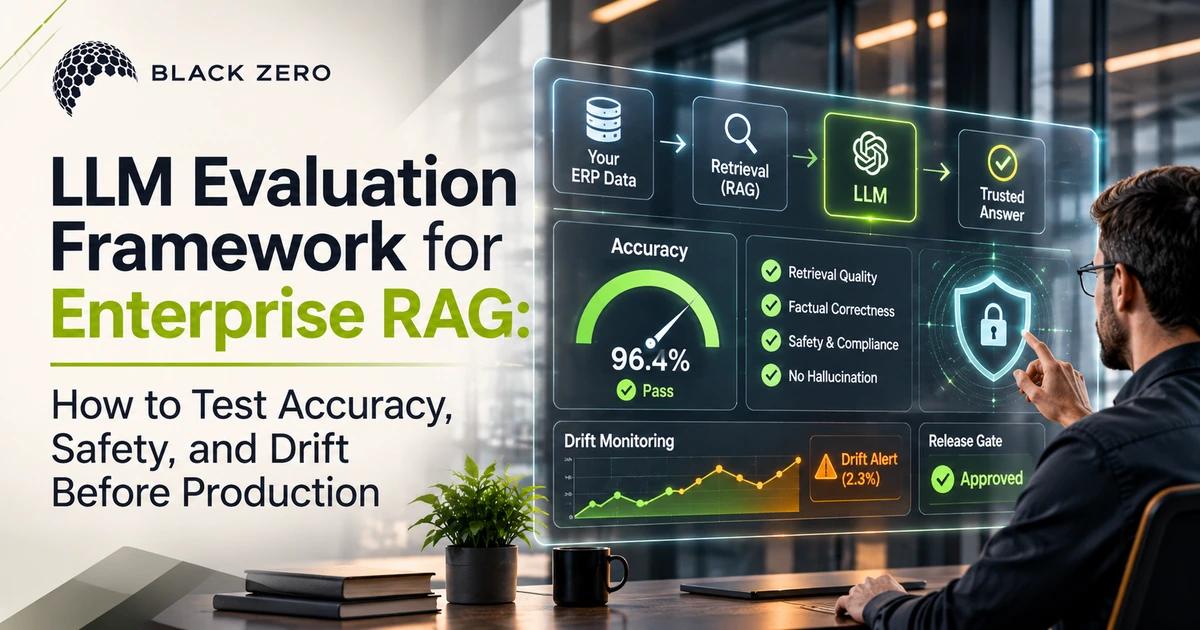
LLM Evaluation Framework for Enterprise RAG: How to Test Accuracy, Safety, and Drift Before Production
An LLM evaluation framework assesses the accuracy of information retrieval, factual correctness, security, and system costs using verified queries prior to release, while also continuously monitoring performance post-launch.
Teams developing a private RAG assistant over ERP data employ automated "release gates" to detect incorrect citations, silent errors, and data inconsistencies before a release ensuring that executives are not presented with inaccurate figures.
Why Demos Pass and Production RAG Fails
Demos conducted in a boardroom often appear successful because engineers test the system using clean data and straightforward queries. In real-world environments, however, user queries tend to be far more complex and ambiguous. Users frequently ask multi-step questions, while the company internal folders and files are subject to constant, weekly updates.
Without a golden dataset and an LLM evaluation framework, the information retrieval process can fail silently—meaning that system errors do not immediately become apparent. Integrating automated checks with human oversight and human-in-the-loop review enables the timely identification and correction of these flaws.
Who Owns Evaluation
The evaluation process is not effective when the responsibility for the entire procedure rests with a single individual. Product leaders determine which business risks are acceptable, machine learning engineers maintain the testing pipelines, and subject matter experts verify complex questions and their corresponding answers.
The Four Layers of an LLM Evaluation Framework
A robust LLM evaluation framework divides the testing process into four core components: Retrieval, Generation, Safety, and Operations. Tracking RAG evaluation metrics within each of these components enables decision-making based on precise results rather than mere guesswork.
For instance, measuring retrieval precision and recall helps determine whether incorrect answers stem from the selection of the wrong document chunks, or from the model ability to accurately comprehend the information and reason through it correctly.
Building the Golden Dataset
Start with 100 to 250 real-world queries derived from support logs and daily workflows. Have subject matter experts draft authoritative answers to these queries and identify the relevant excerpts from the original documentation. This will create your golden dataset (a collection of verified data).
| Layer | Metric | Method | Release Gate |
|---|---|---|---|
| Retrieval quality | RAG evaluation metrics (recall and ranking) | Automated benchmark | Recall >= 0.80 |
| Answer grounding | Hallucination rate | Claim verification | Under 2% |
| Safety and jailbreak resistance | Policy violation count | Red-team suite | Zero critical leaks |
| Latency and cost per query | p95 speed and token spend | Load replay | Under 2.5s and budget |
| Regression after prompt or model change | Score variance | CI pipeline run | Max 2% drop |
| Production drift | Weekly quality shift | Live trace sampling | Alert on 5% dip |
Measuring Hallucinations: Automated and Human Review
Assessing groundedness and faithfulness ensures that every claim made in a generated response aligns directly with the source documents and relevant excerpts. Teams often employ an LLM-as-judge approach within their LLM evaluation framework to rapidly evaluate and score thousands of responses.
However, automated evaluation systems sometimes fail to grasp the nuances and technical intricacies specific to certain domains. Therefore, it is essential to conduct human reviews of 3% to 5% of the generated responses each week to effectively keep the hallucination rate—the frequency with which a model provides incorrect or fabricated information—at a low level.
Security and Safety Testing for Enterprise LLMs
Enterprise RAG systems contain sensitive information, such as payroll files, contracts, and customer records. Before launching the system, it is essential to conduct Red-Team Testing, an assessment designed to uncover security vulnerabilities. This includes testing for threats such as prompt injection (attempts to mislead the system via prompts), Jailbreaks (attempts to bypass the system security constraints), and Cross-Role Permission Leaks (unauthorized access across different user roles).
Incorporating access rules into your LLM evaluation framework ensures that junior staff cannot access restricted or unauthorized files. Furthermore, this practice supports compliance with U.S. regulatory requirements by facilitating the implementation of explainable AI for US compliance.
Production Monitoring, Drift, and Continuous Evaluation
Launching software actually marks the beginning of the most challenging phase. A robust LLM observability system records prompts, retrieved document chunks, latency, and user feedback for every request.
When the system live performance metrics fall below established thresholds, engineers convert these failing traces into new test cases to conduct regression testing. Continuous LLM observability enables the timely detection of subtle shifts and performance degradations often caused by stale knowledge bases or upstream model updates that might otherwise go unnoticed.
Frequently Asked Questions
1. What is an LLM Evaluation Framework?
An LLM evaluation framework is a structured and repeatable testing system used to assess accuracy, the hallucination rate (the frequency of providing incorrect or fabricated information), security, and speed both before each new software release and during actual use by real-world users.
2. Which RAG Evaluation Metrics are the Most Important?
Key RAG Evaluation Metrics such as retrieval recall, answer accuracy, task completion, response speed, and per-query cost should be prioritized. This enables engineering teams to pinpoint the root cause of errors and implement precise solutions.
3. How Often Should Re-evaluation Take Place?
Perform offline testing whenever changes are made to prompts, models, or indices. Additionally, continuously monitor performance on a weekly basis using sampled production traffic (requests from real users).
Ready to Build a Secure AI Assistant for Your Enterprise?
Are you ready to transform your AI pilot into a reliable production system? BlackZero Technologies facilitates the development, testing, and continuous monitoring of enterprise RAG pipelines, anchored by an LLM evaluation framework tailored to your specific requirements.
Explore our custom AI engineering services to bring your AI solutions to life with verifiable accuracy.