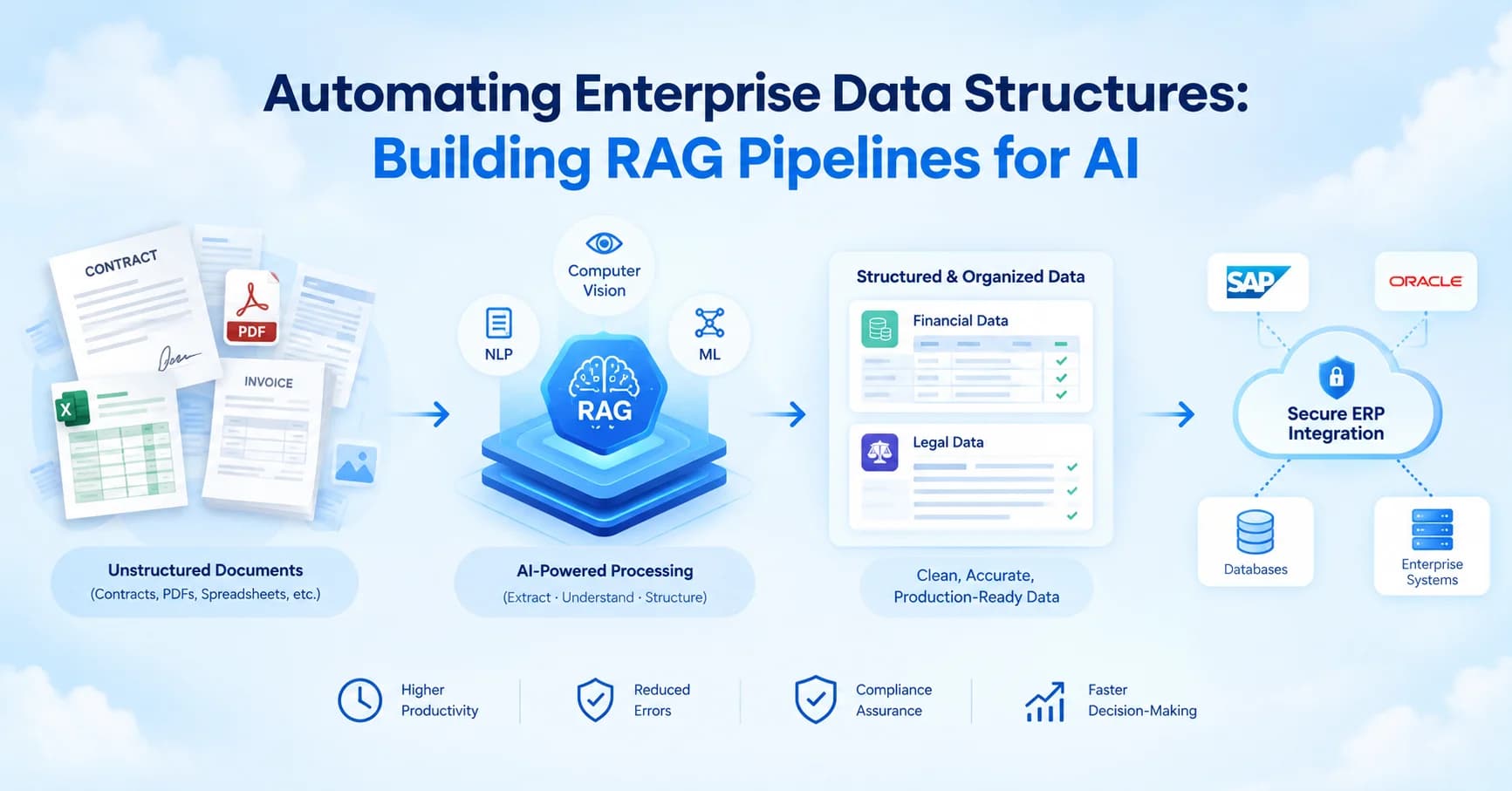
Intelligent Document Automation: Structuring Financial and Legal Workflows
Corporate organizations are overwhelmed by a vast amount of unorganized data every day. From scanned contracts and PDF files to messy spreadsheets, employees in finance and legal departments waste countless valuable hours manually entering records into software. Human data entry not only reduces productivity but also significantly increases the chances of costly errors and important information being overlooked.
Innovative intelligent document automation helps to overcome this obstacle. It transforms unorganized and fragmented records into organized, usable, and production-ready digital assets.
The Hidden Cost of Manual Data Extraction in Corporate Sectors
Relying on manual staff to extract data severely hinders operational efficiency. Organizations across the U.S. lose millions of dollars each year correcting clerical errors, delays in record reconciliation, and typos that occur when re-entering data.
Just one mistyped digit or overlooked clause can result in serious compliance risk management fines and costly regulatory audits. Furthermore, relying on human input at the keyboard prevents business teams from effectively scaling their operations during busy fiscal quarters.
Modern businesses can no longer sustain manual data handling given the increasing need for fast, error-free work.
How Intelligent Document Processing Actually Works
Traditional systems often relied on rigid and fixed templates, which failed when the margins of an invoice changed by even a few millimeters. Todays advanced platforms combine Computer Vision with advanced machine learning algorithms to dynamically understand the context of a document.
By combining Natural Language Processing (NLP) and context-aware layout models, the system is capable of truly understanding forms, unstructured blocks of text, and complex contractual language. It does not just record the coordinates or location of pixels, but processes information accurately by understanding the Context of the document.
Transforming Legal and Financial Workflows
Implementing Automated Intelligence can deliver major operational efficiency gains in corporate areas:
Automated Financial Workflows: Accounting departments can directly enter billing records, vendor invoices, and tax filings into the ledger database without any manual human intervention through invoice processing automation.
AI Legal Document Processing: Legal professionals can review thousands of pages of non-disclosure agreements (NDAs), purchase agreements, and regulatory filings with the help of unstructured data extraction, and identify clauses with unusual financial liabilities and potential legal risks in just a few seconds.
Legacy OCR vs Modern AI Document Automation
Older scanning utilities fail to meet the dynamic demands of modern data architectures.
| Operational Feature | Legacy OCR Systems | Modern AI Document Platforms |
|---|---|---|
| Format Dependency | Rigid templates; fails on layout changes | Template-free; understands contextual variations |
| Data Accuracy | Moderate; struggles with skewed or low-res text | High; continuously refines output via feedback loops |
| Setup Time | Weeks of custom coordinate rule configuration | Rapid deployment with pre-trained models |
| Enterprise Scalability | Poor; requires manual intervention per format | High; processes massive batches concurrently |
While older optical character recognition OCR tools only identified the characters on a page, modern automated data extraction technology is capable of understanding the meaning, relationships, and structure of data from disparate and heterogeneous sources.
Secure ERP Integration for Seamless Operations
Extracting text from raw data records is only half the battle. To achieve real and measurable business benefits, clean and organized data must be securely and efficiently transferred to core business systems such as SAP, Oracle, or the organization own proprietary enterprise repositories.
Enterprise ERP integration requires robust and reliable secure data pipelines, based on private cloud architecture, tokenized endpoints, and strict data isolation. This configuration eliminates the risk of data loss, ensures the protection of confidential records, and enables immediate access to information for internal departments.
Conclusion
Intelligent document automation is a critical cornerstone of any comprehensive digital transformation strategy. When forward-thinking organizations replace manual data entry with robust and reliable AI pipelines, they significantly reduce operational costs, eliminate compliance risks, and accelerate critical business decision-making.
Automate Your Enterprise Workflows with Black Zero
Do not let unorganized documents slow your organization growth. Partner with Black Zero expert engineering team and create custom, enterprise-grade AI ingestion pipelines tailored to your specific infrastructure.
Contact Black Zero today and transform your raw corporate data into a flexible and effective operational asset using our customized solutions.