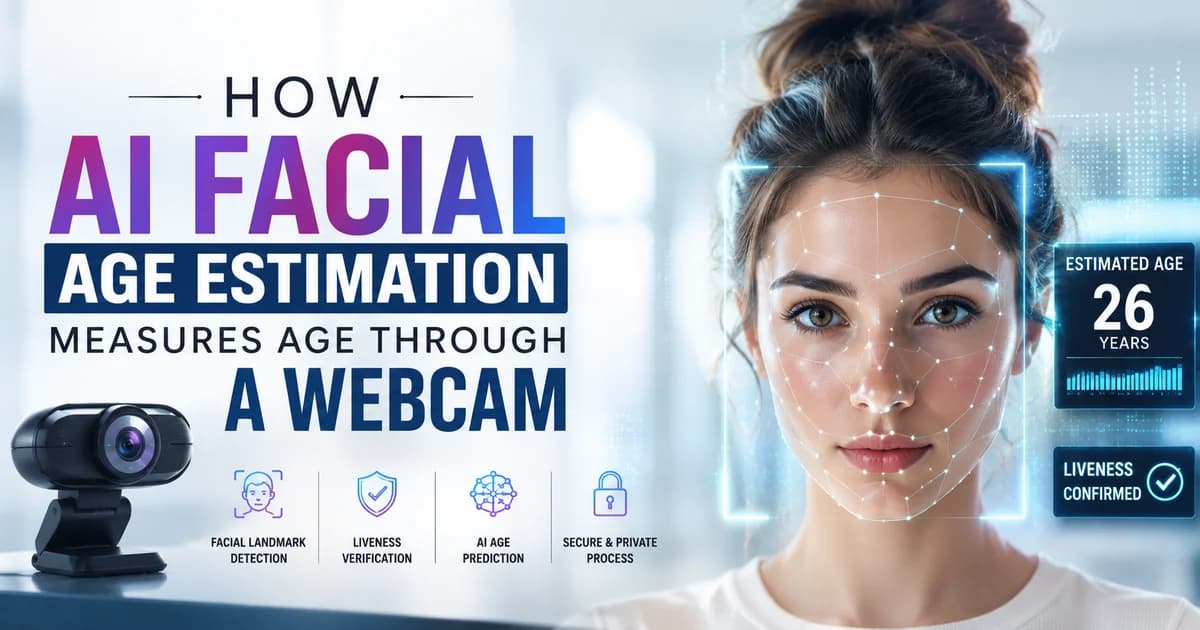
Have you ever wondered how a website can guess your age just by looking at a selfie through a standard webcam device? It might feel like magic, but it relies on highly advanced computer vision and machine learning frameworks. As digital platforms seek to protect children and meet strict legal requirements globally, AI facial age estimation is rapidly becoming a standard tool. In this comprehensive guide, we will explore exactly how a basic camera can predict how old someone is and why this technology is transforming digital safety.
The Core Process of Facial Age Estimation
When you grant a secure website access to your camera, the system performs a series of rapid calculations behind the scenes. The workflow begins with locating the face. The software scans the live video feed to find a human face, identifying key structural landmarks. These landmarks include the pupils, the corners of the eyes, the bridge of the nose, and the boundaries of the lips.
Once the face is located, liveness verification occurs. To ensure someone is not simply holding up a printed photograph or playing a pre-recorded video, the system performs advanced anti-pre-recording. It looks for micro movements like blinking or slight head shifts to confirm a real breathing person is present before the camera.
Following this, the algorithm moves to feature analysis. It analyses biological traits and micro-movements predictably as humans age. It examines skin texture, jawline contour, and the exact geometric distances between various facial landmarks. As people grow from childhood into adulthood, these facial proportions shift in highly measurable ways.
Finally, the system executes a neural network prediction. It compares the detected facial data against a neural network trained on millions of diverse faces with verified ages. It then outputs an estimated age or confirms if the person is above a specific legal threshold, like eighteen years old.
Traditional Verification vs AI Facial Age Estimation
Organizations are adopting this modern technology because it perfectly balances platform safety with user convenience. Traditional age verification often requires physical documents, which can be risky to share and slow to process.
| Verification Feature | Traditional Document Check | AI Facial Age Estimation |
|---|---|---|
| User Privacy | Requires sensitive personal ID | No personal records needed |
| Processing Speed | Slow manual review process | Instant real-time verification |
| Data Security | High risk of data breaches | Images are deleted instantly |
| User Accessibility | Excludes users without documents | Works for anyone with a webcam |
AI facial age estimation offers better digital privacy because the system does not require users to upload physical identification documents like passports or driver licences that contain highly sensitive personal details. It also ensures high data security. Most platforms process the image instantly and delete it immediately, leaving no data stored on servers for hackers to steal or misuse in the future.
Furthermore, this approach provides exceptional speed and ease. Users can securely verify their age in seconds using a device they already own, avoiding lengthy manual review processes that frustrate online visitors. Finally, it heavily improves accessibility. It allows younger users who do not yet possess government-issued identification to access appropriate digital spaces safely and anonymously.
Common Use Cases Across Industries
The applications for this technology are growing across numerous sectors worldwide. In social media and gaming, age estimation is restricted from adult content and prevents them from interacting with older strangers in online gaming lobbies. Within retail sales, companies use the software to restrict the purchase of age-restricted goods during the online checkout process, helping them comply with local laws and regulations. Digital services also utilize these advanced machine learning frameworks to protect children from targeted advertising or data collection mechanisms that violate strict child privacy regulations.
Understanding Accuracy and Technical Limitations
While modern machine learning systems are highly capable, they are not entirely flawless. Leading models can estimate age with an error margin of about one to three years, particularly for children and young adults, where age gating is most critical. However, the software can struggle with older demographics, where the margin of error typically increases because signs of ageing become much more varied.
Several external variables can impact the final mathematical result. Lighting conditions, camera angles, and the overall megapixel quality of the webcam hardware all play a significant role. The presence of heavy makeup, thick facial hair, or oversized prescription glasses can also obscure necessary data points. Additionally, skin tone and demographic factors must be considered. Developers actively train their algorithms on globally diverse datasets to minimize bias and ensure maximum fairness across all populations.
The Future of Digital Identity
AI facial age estimation represents a massive advancement in online safety and overall user experience. By using a quick camera scan rather than collecting permanent personal records, platforms can heavily protect vulnerable users while respecting individual privacy boundaries. As the underlying neural networks continue to learn and process more diverse data, this technology will only become more precise and seamless. We are entering an era where your face acts as a secure temporary key to age-appropriate content.
Frequently Asked Questions
Does AI facial age estimation store personal data?
No. The system processes the live image instantly and deletes it immediately, ensuring no biometric data is stored on servers.
Can a printed photograph trick AI age estimation?
No. The software uses liveness checks to detect micro movements like blinking, completely blocking fake photos or videos.
How accurate is age prediction through a standard webcam?
It is highly accurate, typically estimating age within a 1 to 3 year margin of error, which is highly effective for age gating.
Why use AI instead of checking ID documents?
AI provides instant, anonymous age verification without forcing users to upload sensitive government IDs that hackers could steal.