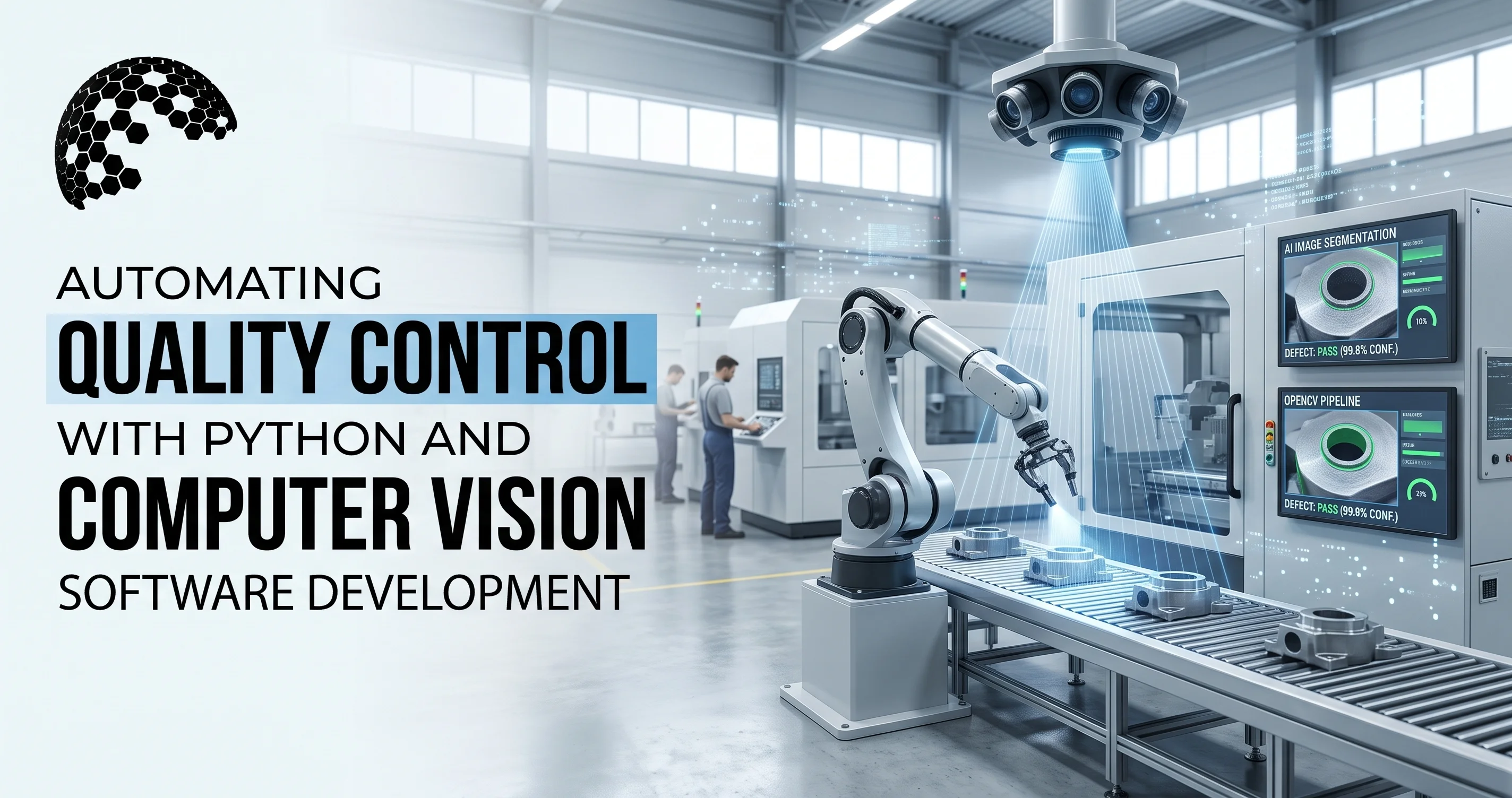
Automating Quality Control with Python and Computer Vision Software Development
Manufacturing directors and chief technology officers in the United States constantly face challenges regarding time and accuracy on the factory floor. Manual visual inspection on complex assembly lines is typically very slow and carries a high risk of human error. When human operators spend hours observing rapidly moving mechanical parts, errors become inevitable. Adopting computer vision software development is a crucial step toward identifying defects in real-time and optimizing production workflows. Transitioning from traditional human oversight to intelligent machine scanning ensures that every product leaving the factory meets the highest quality standards. This technological advancement enables industrial businesses to redirect human talent away from repetitive visual inspections and toward critical tasks, such as solving complex problems.
The Limitations of Manual Inspection in Modern Manufacturing
Traditional human-based quality control essentially fails when implemented at a large industrial scale. As production line speeds accelerate to meet the growing demands of global supply chains, human inspectors inevitably succumb to severe physical fatigue. This physical and mental exhaustion, combined with the rapid pace of modern manufacturing, leads to inconsistent, subjective judgments during visual inspections. One worker might flag a minor structural defect in a product, while another might overlook it entirely.
Consequently, industrial plants in the US frequently face costly product recalls, raw material waste, and significant operational inefficiencies. Increasing the workforce to meet these high-speed production demands merely multiplies financial burdens without truly resolving the underlying issue of accuracy. Ultimately, relying on human eyes to detect persistent, minor defects creates an unavoidable bottleneck that hinders true industrial scaling and severely damages brand reputation when defective products eventually reach the consumer.
Leveraging Python AI Frameworks and Computer Vision APIs
The technical architecture of modern automated inspection relies heavily on robust and highly optimized code. Software engineers utilize powerful Python AI frameworks—alongside renowned open-source libraries like OpenCV—to develop resilient factory inspection pipelines.
By deploying advanced machine learning models in Python, industrial facilities can instantly process video feeds from high-resolution cameras directly on the factory floor. This specialized edge computing approach ensures the immediate detection of critical defects without the detrimental latency associated with network transmission. Processing visual data locally allows assembly lines to operate without interruption while simultaneously identifying physical irregularities that are completely invisible to the human eye.
Comparing Traditional QC Methods and AI Vision Automation
Examining the operational differences clarifies why factories are upgrading their quality assurance systems.
| Evaluation Metric | Manual Human Inspection | AI Computer Vision Automation |
|---|---|---|
| Inspection Speed | Slow and limited by human fatigue | Real-time continuous line scanning |
| Defect Accuracy | Subjective and inconsistent | High-precision pixel-level detection |
| Operational Cost | High recurring labor overhead | Scalable automated software processing |
| Data Tracking | Manual paper logbooks | Automated digital logging and analytics |
Integrating AI Software for Manufacturing and Image Segmentation
Detecting minute defects on high-speed production lines requires highly specialized algorithmic tools. By integrating specific AI software for manufacturing with precise image segmentation software, industrial cameras can isolate and identify structural flaws with pixel-level accuracy. However, off-the-shelf solutions are often ill-suited to the unique physical requirements of a specific factory floor.
Partnering with expert engineering teams for custom AI software development and specialized enterprise AI development services ensures that the underlying technical architecture is fully tailored to detect the highly specific types of irregularities associated with particular products. Implementing the best object detection software for developers grants plant managers comprehensive oversight, enabling them to train custom neural networks to capture a wide range of defects—from microscopic cracks in automotive metal to slight misalignments on pharmaceutical labels.
Upgrade Your Assembly Line with Black Zero
Industrial leaders in the US looking to fundamentally modernize their production facilities should consult the engineering experts at Black Zero. As a premier technology partner specializing in secure API integrations and automated industrial intelligence systems, Black Zero delivers exceptional technical expertise.
Whether your factory requires the integration of advanced robotics with legacy hardware or the implementation of comprehensive visual intelligence engineering from the ground up, our team provides fully customized, scalable software solutions tailored to your unique production environment. Future-proof your factory by replacing inconsistent manual labor with artificial intelligence. Contact us today to discover how the implementation of advanced visual processing algorithms can significantly reduce operational costs and permanently eliminate costly production errors across your entire manufacturing pipeline using our advanced analytics systems.