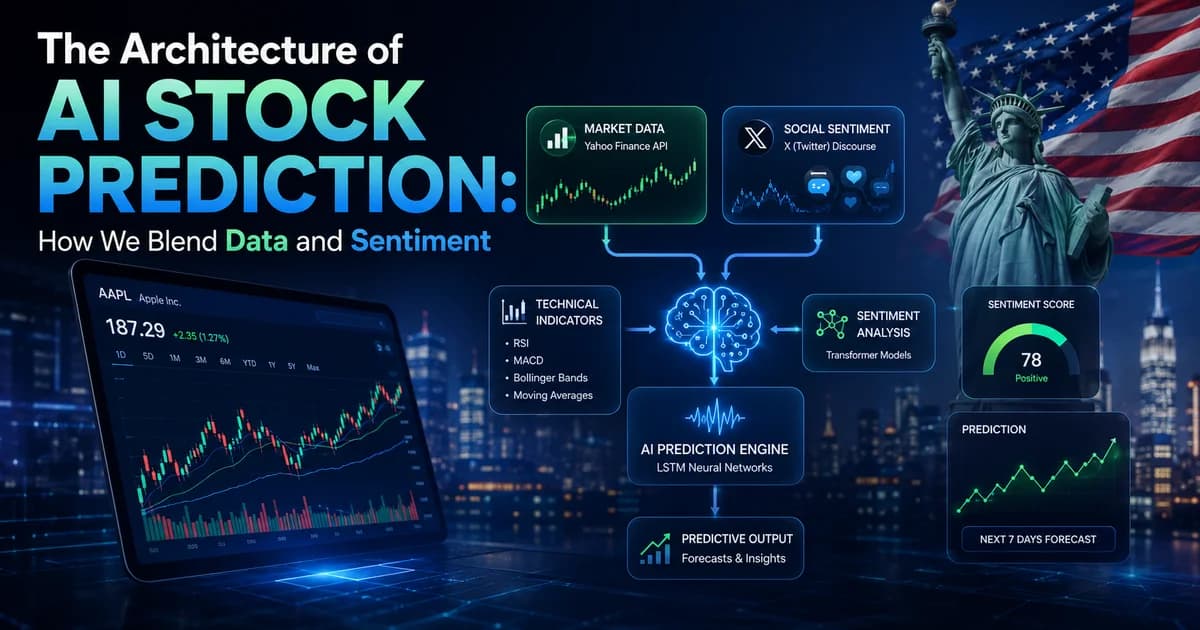
The technical framework behind our AI stock prediction engine in the USA at Black Zero represents a sophisticated convergence of time-series analysis and natural language processing. By integrating historical market data with real-time social sentiment, we have created an analytical tool that moves beyond traditional chart reading.
The foundation of this system rests on a robust dual-stream data pipeline. We ingest structured historical data from the Yahoo Finance API, ensuring that every asset class is normalized for splits and dividends to provide a clean baseline. Simultaneously, our sentiment module monitors discourse on X, applying advanced linguistic models to derive quantifiable sentiment scores.
The core technical challenge lies in the temporal synchronization of these two distinct data formats. We implement a sophisticated timestamp-based merging strategy that aligns discrete market intervals with continuous social activity, using rolling windows to produce a smoothed sentiment vector that correlates directly with price volatility and volume shifts.
Advanced Feature Engineering and Neural Networks
Feature engineering is a critical component of our pipeline. We do not rely on raw pricing data alone. Our system calculates a comprehensive suite of technical indicators, including Relative Strength Index, Moving Average Convergence Divergence, and Bollinger Bands, which serve as foundational inputs for our AI stock market analysis.
The table below breaks down the core technical components that drive our predictive modeling:
| System Component | Technology and Source | Primary Function |
|---|---|---|
| Market Data Pipeline | Yahoo Finance API | Provides structured historical pricing and volume |
| Social Sentiment | X Discourse Analysis | Derives quantifiable sentiment scores from text |
| Sequential Modeling | LSTM Neural Networks | Preserves long-term trends and filters market noise |
| Semantic Analysis | Transformer Models | Extracts high-intent financial meaning from chatter |
These indicators, combined with our sentiment embeddings, are fed into a specialized Long Short-Term Memory neural network. This architecture is chosen for its capacity to handle sequential dependencies. The internal gate mechanism of the LSTM allows the model to preserve long-term market trends while filtering out transient noise that frequently plagues financial datasets.
For the sentiment component, we leverage Transformer-based models to extract deep semantic meaning from textual data, allowing the engine to distinguish between casual chatter and high-intent financial discourse that carries genuine market weight.
Optimizing Computational Efficiency for Real-Time Markets
Computational efficiency is paramount in an environment where speed defines relevance. To ensure our predictions remain actionable, we have optimized our entire processing pipeline for minimal latency. We utilize asynchronous data fetching and GPU-accelerated tensor operations to manage the heavy computational load through our AI software hub for real-time inference.
By implementing model quantization, we significantly reduce the footprint of our neural networks, allowing for rapid generation of forecasts for predictive trading models in the USA regardless of the time horizon selected by the user. This technical efficiency ensures that the model remains responsive without requiring reliance on high-latency cloud connections.
Maintaining Technical Rigor and Backtesting Standards
Technical rigor is further maintained through an exhaustive backtesting framework. We evaluate the performance of our models against diverse historical market cycles, moving beyond simple accuracy metrics to focus on the Sharpe ratio and maximum drawdown. This approach ensures that our predictions account for both the direction of the price and the inherent volatility of the underlying asset.
Because this AI sentiment analysis stock prediction engine serves as a proprietary internal tool, we prioritize auditability. The system provides transparency into the specific weightage assigned to technical indicators versus social sentiment for every individual forecast. This allows our team to analyze the logic driving each prediction, ensuring that our outputs remain grounded in empirical data. Ultimately, this integration of engineering and finance demonstrates that the most effective way to navigate chaotic market conditions is to build systems that treat data, psychology, and mathematical modelling as a single, unified source of truth.