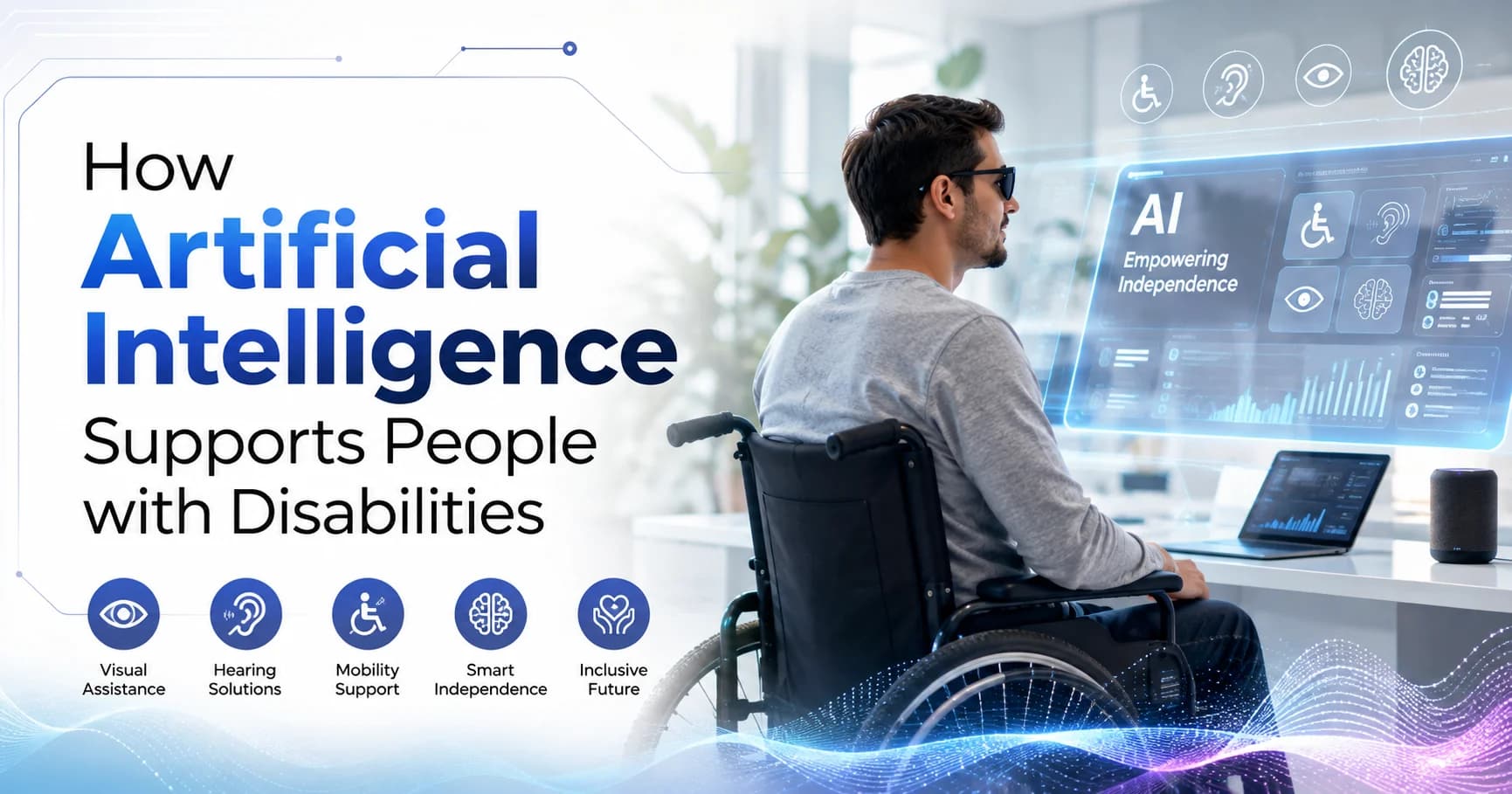
Empowering Lives: How Artificial Intelligence Supports People with Disabilities
There are often unseen digital and physical obstacles to overcome in day-to-day living. Fortunately, long-standing obstacles are being removed by contemporary technical advancements, creating previously unheard-of levels of personal freedom. These days, sophisticated algorithms provide real-time adjustments, enabling people to confidently manage their daily schedules and professional workplaces.
AI now acts as a vital link for those with disabilities, transforming difficult everyday obstacles into doable, customized experiences that promote genuine autonomy in all facets of life.
The Role of Assistive Technology Artificial Intelligence
Static accessibility settings are becoming obsolete on modern digital platforms. Assistive technology artificial intelligence develops responsive digital experiences that instantly adjust to specific user demands by examining individual user behavior and physical settings. By using these cognitive tools, forward-thinking companies can guarantee that digital products continue to be user-friendly for all.
Additionally, including intelligent features enables businesses to stay in constant compliance with ADA standards, guaranteeing that online platforms continue to be hospitable, legally compliant, and truly functioning for each and every visitor.
Restoring Independence for the Visually Impaired
In the past, people with visual loss had to rely heavily on outside help to complete daily duties. This relationship is being drastically altered by contemporary computer vision techniques. Smartphone apps can now describe real environments, read fine print on product labels, and instantaneously recognize familiar faces thanks to specific visual impairment tech.
Visually impaired people can easily browse, shop, and work online when they are linked with sophisticated screen readers that comprehend web page context rather than just reciting raw code.
Smart Hearing Solutions and Communication
Human connection is fundamentally based on communication, but those who are hard of hearing or deaf are frequently isolated in surroundings with high levels of sound. Artificial intelligence uses lightning-fast natural language processing to close this gap.
Automated voice recognition systems provide instantaneous, extremely accurate subtitles during hectic business meetings or informal talks. Additionally, neural networks are used by contemporary smart hearing solutions to decrease distracting background noise in congested areas while isolating human voice frequencies.
Traditional Tools vs Modern AI Accessibility
Rigid, one-size-fits-all solutions were frequently used by legacy systems, which were unable to adjust to the intricacies of the real world. These static tools are being replaced by dynamic systems that gradually learn from user behavior by engineering teams dedicated to accessible software development in the United States.
| Feature | Traditional Methods | Modern AI Solutions |
|---|---|---|
| Screen Reading | Basic text-to-speech algorithms | Context-aware emotional voice reading |
| Hearing Assistance | Simple volume amplification | Intelligent background noise filtering |
| Physical Mobility | Standard manual wheelchairs | Predictive robotic exoskeletons |
| Workplace Support | Generic scheduling tools | Custom neurodivergent workplace tools |
Enhancing Physical Mobility with Smart Robotics
Navigating digital devices or real settings can be taxing for people with physical disabilities. By directly integrating machine learning algorithms into mobility devices, modern robotics is transforming this reality. Smooth, natural stability is provided by advanced limbs and intelligent prosthetics that forecast movement by analyzing muscle impulses and walking patterns.
Simultaneously, voice-controlled smart environments enable individuals with restricted hand movement to operate workstations, doors, and lights with straightforward language cues.
Conclusion
When technology unites people and eliminates needless boundaries, it fulfills its greatest potential. Developers and organizations may unlock enormous human potential that was previously unrealized by continuously improving AI for people with disabilities.
Making universal access a top priority creates a more equitable digital environment where everyone has the resources they need to thrive.
Upgrade Your Digital Infrastructure with Black Zero
Are you prepared to enable all users to access your digital products? Collaborate with Black Zero to incorporate state-of-the-art accessibility features customized for your platform. To set the standard for accessible software development in the USA, get in touch with our engineering team right now.