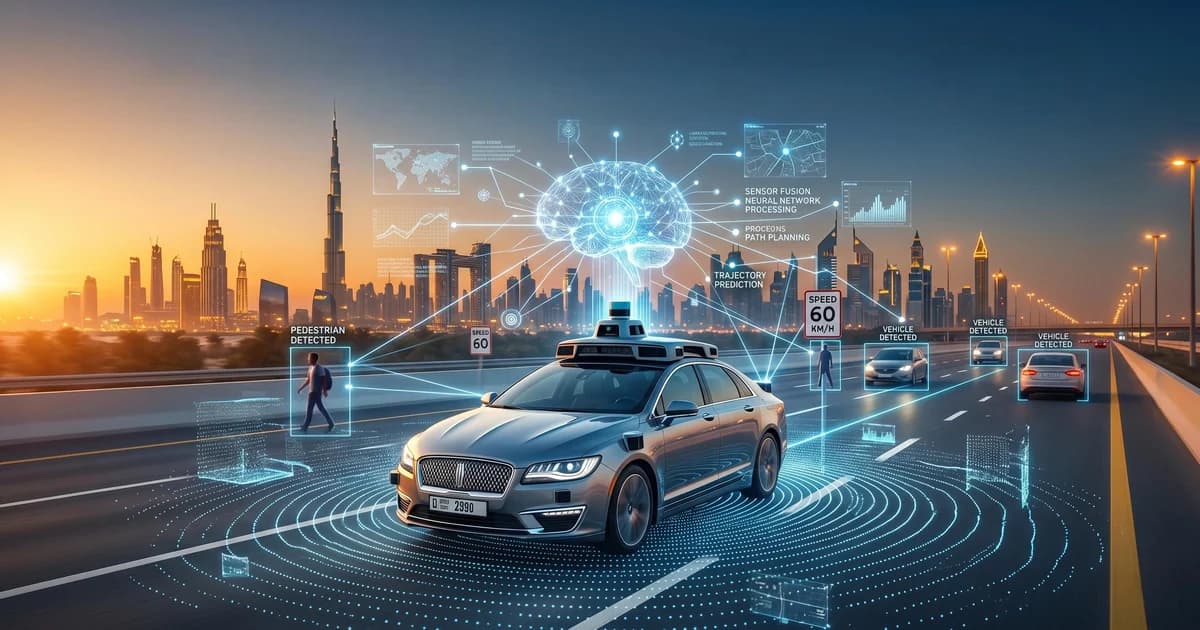
The AI Brain Inside Self-Driving Cars: Sensor Fusion and Deep Learning
Autonomous vehicles navigating city streets across the United States—from San Francisco and Phoenix to Austin—rely on artificial intelligence and edge computing to observe, interpret, and react to complex traffic scenarios in real time.
Sensing the Environment Through Multi-Modal Telemetry
A self-driving vehicle operates as a high-throughput data center on wheels, processing gigabytes of sensor telemetry every second across three primary modalities:
| Sensor Technology | Primary Function | Operational Advantage on US Roads |
|---|---|---|
| Optical Cameras | Visual object, lane, and sign classification | High-resolution color recognition for traffic signals |
| Radar Sensors | Relative velocity and distance measurement | Penetrates heavy rain, snow, and highway fog |
| LiDAR Systems | 360-degree 3D point-cloud depth mapping | Centimeter-level accuracy day or night |
Sensor Fusion and Path Planning
By blending camera, radar, and LiDAR feeds through deep neural networks, the onboard computer constructs a unified 3D occupancy grid, predicts pedestrian and vehicle trajectories, and dispatches millisecond commands to steering and braking actuators.
Revolutionize Your Software Architecture with Black Zero
At Black Zero, we engineer high-performance computer vision pipelines, real-time telemetry systems, and custom artificial intelligence models for US enterprises. Contact our engineering team today.


