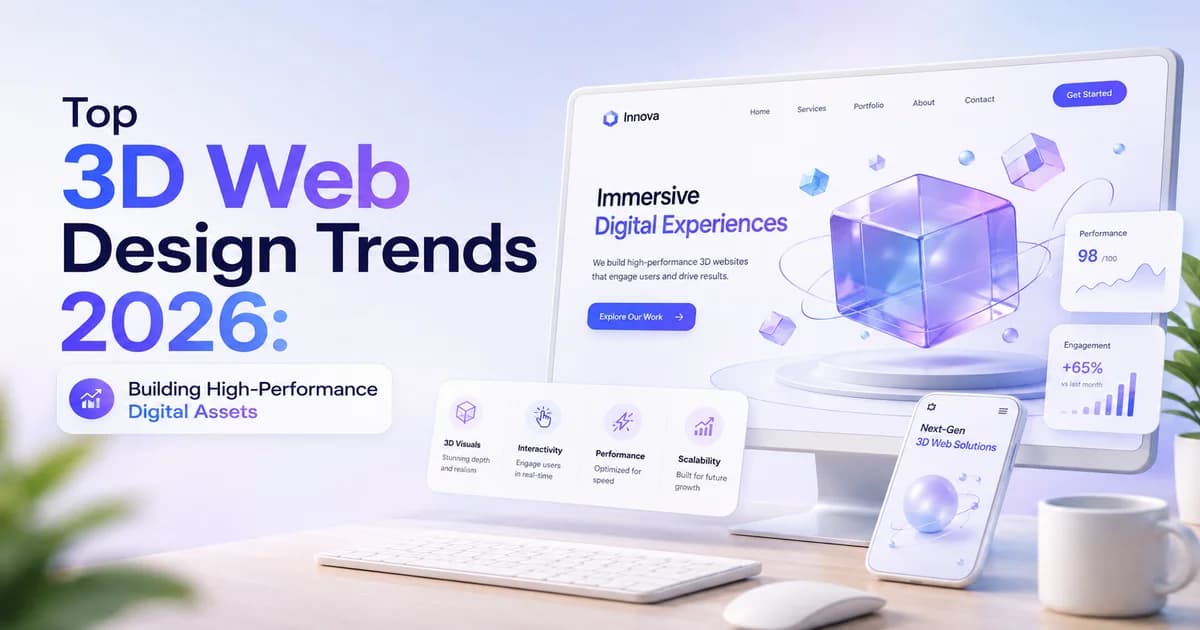
Top 3D Web Design Trends 2026: Building High-Performance Digital Assets
Modern online platforms are moving beyond flat layouts to create interactive 3D digital environments. Adopting the latest 3D web design trends of 2026 helps US enterprises create immersive digital experiences that transform static corporate websites into memorable destinations.
The Shift Towards Interactive Motion and Glassmorphism UI
When spatial motion graphics are combined with modern glassmorphism UI, websites gain frosted glass depth, subtle background blur, and high-contrast visual hierarchy. This layered visual style increases user session duration and guides prospects smoothly through technical product narratives.
Integrating Spatial Elements for Modern Digital Branding
Interactive 3D models and WebGL canvases allow enterprise buyers to inspect global data networks, hardware architectures, or supply chain hubs directly in the browser, reinforcing technical authority before the first sales call.
Flat UI vs High-Performance 3D Digital Assets
| Web Design Element | Traditional Flat UI | Immersive 3D Web Design |
|---|---|---|
| Visual Depth | Two-dimensional and static | Dynamic and multidimensional |
| User Interaction | Passive reading and scrolling | Active exploration and engagement |
| Brand Perception | Basic and standard | Premium and futuristic |
| Performance Impact | Average retention rates | Maximized conversion and retention |
How Custom 3D Web Development Drives Business Growth
Implementing spatial elements requires strong front-end engineering so page speed and Core Web Vitals remain fast. Developers optimize geometry, leverage WebGL shaders, and apply progressive compression within advanced web infrastructures so 3D visuals run smoothly across desktop and mobile devices.
Transform Your Digital Identity Today
Partner with the Black Zero creative design and web engineering team to upgrade your web architecture with high-performance 3D digital assets.


